Discover arc de triomf barcelona spain, its story, meaning, location, and why this monument feels quietly powerful and human.
The Arc de Triomf Barcelona Spain is a 19th-century monument built for the 1888 World’s Fair, designed to symbolize progress, culture, and openness rather than military victory.
You’re walking without a checklist. Maybe you’re heading toward El Born. Maybe you’re just following the light. Then, without warning, the Arc de Triomf Barcelona Spain appears in front of you.
It doesn’t interrupt your day. It doesn’t demand attention.
It simply stands there… wide, calm, and strangely welcoming.
At first, you might think it’s just another landmark. Something to photograph and move on from. But the longer you stand there, the more you realize this monument isn’t trying to impress you. It’s trying to include you.
That’s when curiosity kicks in. And that’s where this story begins.
Article Breakdown
What the Arc de Triomf Barcelona Spain Actually Is
Let’s start simple. The Arc de Triomf Barcelona Spain is a ceremonial arch built in 1888. It served as the main entrance to the Barcelona World’s Fair, a global exhibition meant to show the city stepping confidently into modern Europe.
Here’s the part that changes everything.
This arch wasn’t built to celebrate a battle. No war. No conquest. No defeated enemies.
Instead, it celebrates ideas.
Industry. Science. Art. Cooperation.
That choice alone tells you a lot about Barcelona.
Why This Arch Feels Different the Moment You See It
A Triumph Without Violence
When you think of triumphal arches, you probably imagine something heavy and intimidating. Something designed to remind you who won.
The Arc de Triomf Barcelona Spain does the opposite.
It doesn’t tower over you. It doesn’t dominate the skyline.
It invites you to pass through.
And that subtle difference changes how you feel beneath it. You don’t feel small. You feel included.
Brick Instead of Stone
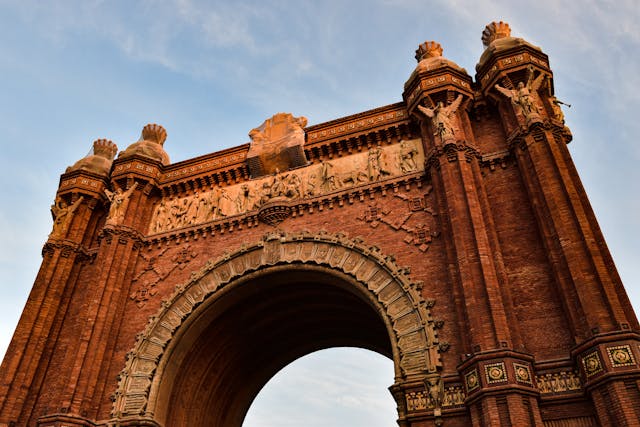
Most arches are carved from pale stone or marble. This one uses red brick, ceramic tiles, and detailed reliefs.
The effect is warmer. Almost human.
It feels less like a monument built for history books and more like one built for everyday life.
The Story Behind Its Creation
Barcelona in the Late 1800s
Picture the city in the late 19th century. Barcelona is growing fast. Industry is booming. The city wants recognition, not as a military power, but as a cultural and economic force.
Hosting the World’s Fair was Barcelona’s way of saying, Look at us. We belong here.
The Arc de Triomf Barcelona Spain became the symbolic front door to that ambition.
An Entrance, Not a Barrier
This matters more than you might think.
An entrance suggests welcome. A gate suggests control.
Barcelona chose an entrance.
The Symbols You Almost Miss If You Don’t Slow Down
You could walk under the arch ten times and never notice what’s carved into it. Most people do.
But if you pause and actually look, the story unfolds.
What the Sculptures Are Saying
The decorative reliefs show Barcelona welcoming nations, celebrating creativity, and honoring progress. There’s a quiet confidence in those images. No arrogance. No dominance.
Just pride.
It’s as if the city is saying, We built this together. Let’s keep going.
Where the Arc Fits Into Your Day
Location That Makes Sense
The Arc de Triomf Barcelona Spain sits between neighborhoods rather than inside one. It connects El Born, Eixample, and Parc de la Ciutadella.
You don’t have to plan a visit. You pass through it naturally.
And that’s intentional.
A Connector, Not a Destination
Some landmarks isolate themselves. This one blends in.
Joggers pass by without looking up. Skateboarders practice nearby. Tourists stop. Locals don’t.
That mix tells you everything.
How the Arc Lives in the Present
Not Frozen in Time
What surprised me most wasn’t the architecture. It was the energy.
The Arc de Triomf Barcelona Spain hosts marathons, protests, parades, and lazy afternoons. It adapts. It participates.
This isn’t a monument you whisper around. It’s one you live with.
You’re Not a Visitor Here
When you sit beneath it, you don’t feel like you’re trespassing on history. You feel like history made room for you.
That’s rare.
Comparing the Arc to Other Famous Arches
| Feature | Barcelona | Paris | Rome |
|---|---|---|---|
| Meaning | Progress and culture | Military victory | Imperial power |
| Materials | Red brick and ceramics | Stone | Marble |
| Purpose | World’s Fair entrance | War commemoration | Empire celebration |
| Feel | Open and civic | Grand and imposing | Authoritative |
Seeing it this way makes something clear.
Barcelona’s arch isn’t about reminding you of the past. It’s about nudging you forward.
The Best Time to Experience It
Morning
Quiet. Reflective. Almost private. You notice details you’d miss later.
Afternoon
Busy. Alive. Full of movement. The arch feels like a stage.
Evening
Golden light hits the brick just right. This is when it feels almost cinematic.
There’s no wrong time. Just different moods.
What You’ll Actually Do There
You won’t climb it. You won’t tour it. You won’t spend hours checking boxes.
You’ll walk through. You’ll sit nearby. You’ll watch people.
And somehow, that’s enough.
The Unexpected Emotional Weight
I didn’t expect this place to make me think. But it did.
There’s something powerful about a monument that celebrates cooperation instead of conquest. Something grounding about a city that chose openness as its symbol.
Standing there, you might catch yourself wondering what we choose to build today. What we choose to honor.
And that quiet question stays with you.
Frequently Asked Questions
What is the Arc de Triomf Barcelona Spain today?
It’s a public landmark, gathering space, and ceremonial point used daily by locals and visitors.
Do you need a ticket to see it?
No. It’s completely free and open at all times.
Why does it look different from other triumphal arches?
Because it was designed to represent progress and culture, not military victory.
How old is the Arc de Triomf Barcelona Spain?
It was completed in 1888.
Is it connected to Parc de la Ciutadella?
Yes. It serves as the formal gateway leading toward the park.
Key Takings
- The Arc de Triomf Barcelona Spain was built for a World’s Fair, not a war.
- Its red brick design makes it feel warm and approachable.
- The arch symbolizes progress, creativity, and cooperation.
- It functions as a living public space, not a static monument.
- Its location naturally connects major neighborhoods.
- You don’t visit it so much as pass through it.
- It reflects Barcelona’s identity as a city that values ideas over power.