
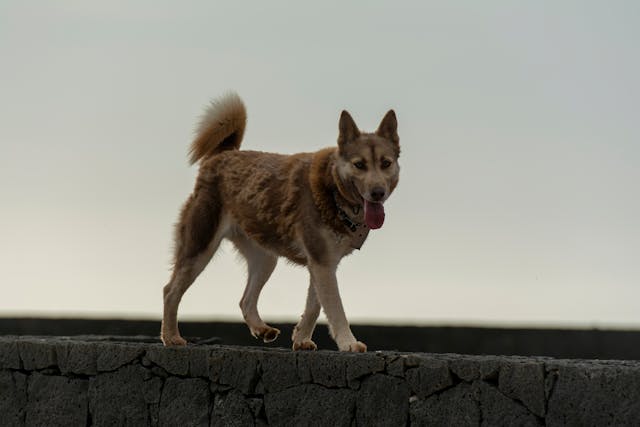
Can a coyote mate with a dog? Learn how coydogs happen, what it means, and the real science behind these rare hybrids.
Yes, a coyote can mate with a dog. They are closely related species and can produce hybrid offspring called coydogs, though it happens less often than people think.
A few summers ago, I was staying at a friend’s farmhouse on the edge of town. His dog, a calm, sleepy Labrador, suddenly became restless after sunset. Ears up. Tail stiff. A low whine I’d never heard from him before.
Then came the howl.
Not a dog’s bark. Not quite a wolf’s call either. Something in between. Wild. Curious. Close.
My friend shrugged and said,
“Probably a coyote. They come near when someone’s dog is in heat.”
That sentence stuck with me longer than the echo of the howl.
Come near? Why?
And then the obvious question formed:
Can a coyote mate with a dog?
I started digging. And like many nature questions, the answer turned out to be both simple and surprisingly layered.
Let’s unpack it together.
Article Breakdown
The Straight Biology: Are Coyotes and Dogs Compatible?
At the most basic level, mating compatibility comes down to genetics.
Coyotes (Canis latrans) and domestic dogs (Canis lupus familiaris) belong to the same genus: Canis. That shared lineage matters more than people realize.
Here’s the quotable science:
“Coyotes, wolves, and domestic dogs can interbreed because they share a recent evolutionary ancestor.”
They all have 78 chromosomes.
That number is key. Matching chromosome counts make viable offspring possible.
So biologically? Yes, a coyote can mate with a dog and produce puppies.
Those puppies are called coydogs.
But biology is only one piece of the story.
What Exactly Is a Coydog?
A coydog is a hybrid offspring from a coyote and a domestic dog. Think of it as nature’s crossover episode.
But unlike deliberate designer breeds (like Labradoodles), coydogs are rarely planned. They happen mostly:
- In rural areas
- On the edges of suburbs
- Where coyotes and free-roaming dogs overlap
And here’s something people often miss:
“Most coydogs are first-generation hybrids; they rarely form stable populations.”
In other words, coydogs exist, but they don’t commonly become their own breed.
Why Coydog Matings Are Rare (Even Though They’re Possible)
If coyotes and dogs can mate, why don’t we see coydogs everywhere?
This is where behavior steps in and complicates the picture.
1) Different Breeding Cycles
Coyotes breed seasonally.
Dogs can breed year-round.
A female coyote is only fertile for a short window once per year, typically late winter.
That mismatch alone reduces chances.
Timing matters in nature more than romance.
2) Wild vs Domestic Behavior
Coyotes are cautious. Strategic. Hyper-aware of threats.
Dogs?
Many are friendly, loud, or dependent on humans.
A coyote doesn’t casually stroll into a yard looking for love. It calculates risk first.
So even if a dog is nearby, the coyote must feel safe enough to approach.
3) Social Structure Differences
Coyotes often form pair bonds and defend territory.
Dogs don’t follow the same social rules.
That difference can make cross-species courtship… awkward, to say the least.
Nature has its own dating rules.
What Do Coydogs Look Like?
Here’s where curiosity kicks in. People want a visual.
Coydogs often look like a blend of both parents, but certain traits show up repeatedly:
- Lean, athletic build
- Long legs
- Narrow chest
- Bushy tail
- Amber or light-colored eyes
- Thick, weather-resistant coat
Behaviorally, they can be:
- Intelligent
- High-energy
- Wary of strangers
- Strong prey-driven
They’re not typical pets.
They’re not fully wild either.
They live in a gray zone.
The Personality Question: Are Coydogs Dangerous?
This is where opinions split.
Some say coydogs are unpredictable.
Others say they can be trained.
Both viewpoints hold some truth.
Coydogs may inherit:
- A dog’s trainability
- A coyote’s caution and independence
That combo can be challenging.
“Hybrids often express wild instincts in domestic settings.”
Translation?
They might escape yards, chase small animals, or resist commands.
Not evil. Not monsters.
Just wired differently.
Legal and Ethical Considerations
Here’s a reality many don’t expect:
Owning a coydog can be restricted or illegal in some places.
Why?
Because hybrids blur wildlife and domestic categories. Laws often don’t know where to place them.
Ethically, deliberate breeding raises questions too:
- Is it fair to the animal?
- Can owners meet its needs?
- What happens if it becomes unmanageable?
These aren’t theoretical concerns. Animal shelters occasionally receive hybrids owners couldn’t handle.
Curiosity shouldn’t outweigh responsibility.
How Common Are Coydogs, Really?
Let’s separate internet myth from reality.
Coydogs are real but uncommon.
Many animals labeled coydogs are simply:
- Husky mixes
- German Shepherd mixes
- Lean mixed breeds
Their wolf-like appearance fuels the assumption.
True genetic confirmation requires DNA testing.
“Visual identification alone is unreliable for detecting coydogs.”
So if someone swears their neighbor owns one…
There’s a decent chance it’s just a striking-looking mutt.
Comparison: Coyote vs Dog vs Coydog
| Trait | Coyote | Dog | Coydog |
| Domestication | Wild | Domesticated | Hybrid |
| Breeding Cycle | Seasonal | Year-round | Variable |
| Temperament | Wary | Social | Mixed |
| Trainability | Low | High | Moderate |
| Human Bond | Minimal | Strong | Unpredictable |
| Survival Skills | High | Low–Moderate | High |
This table shows why hybrids can be complicated. They mix two different survival systems.
Do Coyotes Intentionally Seek Dogs?
Sometimes, yes.
Especially male coyotes seeking mates when female coyotes aren’t available.
But attraction doesn’t equal compatibility.
It’s more opportunistic than romantic.
Urban expansion has increased these interactions.
As cities spread, wildlife adapts.
Nature adjusts faster than we do.
The Human Role in Coydog Occurrences
This part made me pause when I learned it.
Coydog matings often happen because of human behavior:
- Letting dogs roam unsupervised
- Feeding wildlife
- Expanding into coyote habitats
We create the overlap.
Then we’re surprised by the results.
It’s a quiet reminder that ecology isn’t separate from us.
We’re part of the system.
Emotional Reality: Why This Question Fascinates Us
I think people ask “can a coyote mate with a dog” for deeper reasons than biology.
It taps into something primal:
- The boundary between wild and tame
- The idea of nature crossing lines
- Our curiosity about hybrids
There’s mystery there.
A sense that the natural world still holds surprises.
And honestly?
I like that it does.
FAQ Section
Can a coyote mate with a dog naturally?
Yes. It can happen in the wild without human involvement, though it’s uncommon.
Are coydog puppies fertile?
Yes, many are fertile and can reproduce, unlike some hybrids (like mules).
Are coydogs good pets?
Generally, no. They require specialized care and can be unpredictable.
How can you tell if a dog is a coydog?
DNA testing is the only reliable method. Appearance alone isn’t enough.
Do coydogs exist in cities?
Rarely, but possible on suburban edges where coyotes and dogs interact.
Key Takings
- Yes, a coyote can mate with a dog, producing a coydog.
- Coydogs are real but relatively rare.
- Matching chromosomes make hybridization possible.
- Behavioral differences limit how often it happens.
- Coydogs can be challenging to keep as pets.
- Many supposed coydogs are misidentified dogs.
- Human expansion increases cross-species encounters.
Additional Resources:
- Coyote Facts: Trusted wildlife insights explaining coyote behavior, habitat, and interactions with humans.
- Urban Coyotes: Explores how coyotes adapt to cities and why human expansion affects wildlife behavior.