
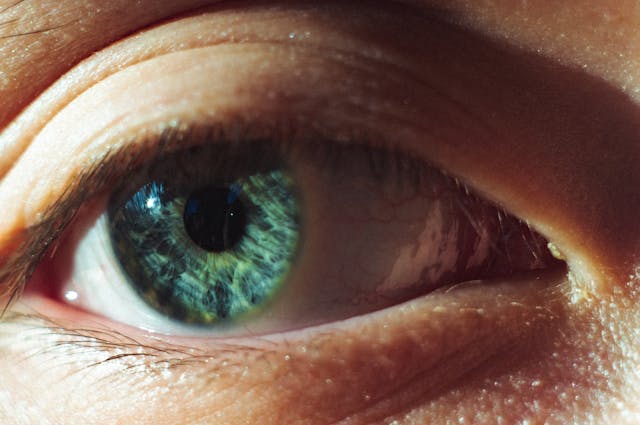
Discover why the area of the retina that doesn’t contain any photoreceptors exists and how your brain quietly hides it.
The area of the retina that doesn’t contain any photoreceptors is called the optic disc. It’s where the optic nerve exits the eye, creating a natural blind spot you never notice.
Here’s a strange thought…
Right now, as you’re reading this, there’s a part of your vision that isn’t actually seeing anything. Not blurry. Not dim. Just not seeing at all.
And yet, you don’t notice it.
That realization hit me hard the first time I really thought about it. Vision feels so smooth. So complete. You assume everything in front of you is being captured somehow. Like a camera. Like a perfect recording.
But it’s not.
There’s an area of the retina that doesn’t contain any photoreceptors. No rods. No cones. No ability to detect light. And somehow, your brain covers it up so well that you live your entire life unaware of it.
Once you notice that… you can’t un-notice it.
So let’s slow this down and figure it out together.
Article Breakdown
What Is the Area of the Retina That Doesn’t Contain Any Photoreceptors?
The area of the retina that doesn’t contain any photoreceptors is called the optic disc.
That name sounds technical, but the idea behind it is simple.
The optic disc is the point where all the visual information collected by your eye leaves the retina and travels to your brain through the optic nerve. Think of it as the exit door.
Because this spot is packed with nerve fibers, blood vessels, and structural wiring, there’s no room for photoreceptors.
No sensors. No light detection. No image formation.
This creates what’s known as a blind spot.
Not a metaphorical one. A real one.
Why Photoreceptors Can’t Exist There
This is where biology makes a compromise.
Your retina is loaded with millions of tiny light detectors. Every one of them needs a connection to the brain. Eventually, all those connections have to gather in one place and exit the eye.
That place is the optic disc.
You can’t put light-detecting cells where all the wiring is bundled together. Something has to give.
So nature chooses function over perfection.
You lose a tiny patch of vision… but you gain a clean, efficient signal pathway to the brain.
It’s not elegant. It’s practical.
And surprisingly, it works extremely well.
Where This Blind Spot Actually Sits in Your Vision
The blind spot created by the area of the retina that doesn’t contain any photoreceptors isn’t centered. It’s off to the side.
Specifically:
- It sits slightly toward your nose
- It appears in your outer field of vision
- Each eye has its own blind spot in a different location
That last detail matters more than you might think.
Because when both eyes are open, one eye fills in what the other eye misses. The overlap hides the gap completely.
You’re not seeing more… you’re seeing smarter.
How You Can Find Your Blind Spot Right Now
If you want to experience this instead of just reading about it, try this.
Close your left eye. Focus your right eye on a small object in front of you. Slowly move another object from the side toward the center.
At some point, it disappears.
Just vanishes.
That moment feels weird the first time. Almost unsettling. Like discovering a missing step on a staircase you’ve walked your whole life.
That disappearance is the area of the retina that doesn’t contain any photoreceptors doing exactly what it’s built to do.
Nothing.
Why You’ve Never Noticed It Before
This part blew my mind when I really sat with it.
Your brain doesn’t show you raw data. It shows you a story that makes sense.
When visual information is missing, your brain:
- Fills the gap using surrounding patterns
- Borrows information from your other eye
- Predicts what should be there
You don’t see a hole. You don’t see darkness. You see continuity.
Your brain edits reality in real time.
That’s not a bug. That’s the feature.
Is This Blind Spot a Flaw or a Feature?
This is where opinions split.
One Way to Look at It
Some people argue the area of the retina that doesn’t contain any photoreceptors is a design limitation.
Other animals don’t have this issue. Their retinal wiring is arranged differently. Their photoreceptors face incoming light directly. No blind spot required.
From that angle, human vision looks slightly compromised.
Another Way to See It
Others say the blind spot doesn’t matter at all.
It’s small. It’s compensated for. It doesn’t affect daily life.
You don’t trip over it. You don’t notice it. You don’t lose function because of it.
Both perspectives can exist at the same time.
How the Optic Disc Compares to Other Parts of the Retina
Understanding the blind spot makes more sense when you compare it to the rest of the retina.
Key Retinal Areas Compared
| Retinal Area | Photoreceptors | Main Role |
|---|---|---|
| Optic Disc | None | Signal exit point |
| Fovea | Dense cones | Sharp central vision |
| Macula | Cones and rods | Detail and color |
| Peripheral Retina | Mostly rods | Motion and night vision |
Every other part of the retina is focused on detecting light.
The optic disc is the odd one out.
It doesn’t see… it sends.
What Happens If the Optic Disc Is Damaged?
This is where things turn serious.
Even though the area of the retina that doesn’t contain any photoreceptors doesn’t detect light, it carries all visual information out of the eye.
If it’s damaged, the consequences can be significant.
Conditions like increased eye pressure, inflammation, or nerve damage can enlarge the blind spot or distort vision permanently.
It’s a reminder that the part that doesn’t see is essential for seeing at all.
The Blind Spot as More Than Anatomy
This might sound strange, but the blind spot feels symbolic.
You’re walking around every day with a missing piece of information, and your brain quietly fills it in so you never feel incomplete.
That’s not just vision. That’s how perception works in general.
You don’t notice what’s missing. You notice what makes sense.
The area of the retina that doesn’t contain any photoreceptors isn’t a weakness. It’s a lesson in how humans experience reality.
Common Misunderstandings About the Blind Spot
Let’s clear a few things up.
- It’s not damage
- It’s not a hole you should worry about
- It’s not something that needs fixing
It’s normal. Universal. Quietly managed.
You’re not losing information. You’re receiving a polished version of it.
Frequently Asked Questions
What is the area of the retina that doesn’t contain any photoreceptors?
It’s called the optic disc, where the optic nerve exits the eye.
Does everyone have this blind spot?
Yes. Every human eye has one as part of normal anatomy.
Why don’t you see the blind spot?
Your brain fills it in automatically using context and input from the other eye.
Can the blind spot change in size?
Yes. Certain eye conditions can make it larger.
Is the blind spot present in both eyes?
Yes, but in different positions, which helps hide it.
Key Takings
- The area of the retina that doesn’t contain any photoreceptors is the optic disc
- It exists because the optic nerve needs an exit point
- This creates a natural blind spot in every human eye
- Your brain fills in the missing visual information seamlessly
- The blind spot is normal and usually harmless
- Damage to the optic disc can affect vision seriously
- Vision is not passive… it’s actively constructed